C-Horizon 2027Poster Awards

Your poster, in front of the right people

A poster puts your work in front of the people best placed to use it. At C-Horizon, the poster floor is where many of the conference’s best conversations begin, and every accepted poster is considered for the Best Poster Presentation Award.

What a poster gets you

Where the best conversations at C-Horizon begin

Reach the people who matter

Present to carbon scientists, industry researchers and funders gathered in one hall.

Pressure-test your results

Discuss your methods and results with specialists across all 27 scientific sessions.

Open doors to collaboration

Learn where your work meets demand, and who can help take it further.

Compete for the award

Every accepted poster is automatically considered for the Best Poster Presentation Award.

Who can enter

Who the poster floor is open to

Anyone working in carbon science and technology may submit a poster abstract. There is no separate entry fee, and you do not need to be an invited speaker.

  • No entry fee
  • No invitation needed
  • Every accepted poster is judged
Who the poster floor is open to: PhD and master’s students; postdocs and early-career researchers; faculty and group leaders; industry scientists and R&D engineers; startup founders in carbon tech; policy researchers and practitioners in sustainability and net zero.
Swipe to see all six

The award

Best Poster Presentation Award

The award recognises the poster that best advances carbon science in originality, clarity and scientific rigour. Winners are announced at the closing ceremony in Dresden.

Winners receive

  • A Certificate of Excellence and a memento
  • A free pass to the next edition of C-Horizon
  • A winner profile on the conference website and social channels

How posters are scored

Criterion 1

Originality

New results, a new approach, or a new application of a known one.

Criterion 2

Relevance

How the work advances carbon science and technology, and who can use it.

Criterion 3

Visual clarity

Layout, figures and text that a non-specialist can follow in two minutes.

Criterion 4

Presentation

How clearly you explain the work and answer the committee’s questions.

An international panel of session chairs and keynote speakers reviews every poster during the dedicated viewing session. The committee’s decision is final.

To be eligible for the award

  • Your abstract must be accepted as a poster presentation by the scientific committee
  • Your registration must be complete and confirmed before the conference
  • You must be present at your poster during the judged viewing session
  • On a multi-author poster, the presenting author is the one considered for the award
  • One poster per presenting author may be entered for the award

Sessions

Pick the session that fits your work

Name one session when you submit. It decides which reviewers see your abstract and where your poster is placed on the floor, so pick the closest fit rather than the broadest.

Carbon materials and structuresSessions 1–7

  1. 01Carbon, Graphene, Nanotube, Fullerene, Diamond
  2. 02Carbonization and Graphitization
  3. 03Carbon Fibres and Composites
  4. 04Carbon Material Synthesis and Characterization
  5. 05Physico-Chemical Properties, Synthesis
  6. 06Low-Dimensional, 2D and 3D Materials
  7. 07Carbon Alloys and Their Applications

Nanoscience and advanced materialsSessions 8–12

  1. 08Nanomaterials and Nanotechnology
  2. 09Nanoscience and Materials Chemistry
  3. 10Materials Science and Engineering
  4. 113D Printed Materials
  5. 12Nano Chemistry

Energy, catalysis and conversionSessions 13–17

  1. 13Carbon in Catalysis
  2. 14Carbon in Energy Storage and Carbon Conversion
  3. 15Hydrocarbons and Biofuels
  4. 16Electrochemistry and Applications
  5. 17Reaction Chemistry and Engineering

Chemistry and computationSessions 18–22

  1. 18Inorganic and Organic Chemistry
  2. 19Quantum Chemistry
  3. 20Computational Modeling and Simulation
  4. 21Green Chemistry and Synthetic Chemistry
  5. 22Technological Advancement in Organic Synthesis

Applications, environment and industrySessions 23–27

  1. 23Environmental Applications
  2. 24Biological and Medical Applications
  3. 25Industrial Applications
  4. 26NetZero and Sustainability
  5. 27Commercialization of Carbon Technologies

Work that spans two sessions?

Name the one your main result belongs to and mention the second in your keywords.

Go to submission

Your abstract

Build your abstract in five parts

Reviewers read hundreds of these, so a clear structure works in your favour.
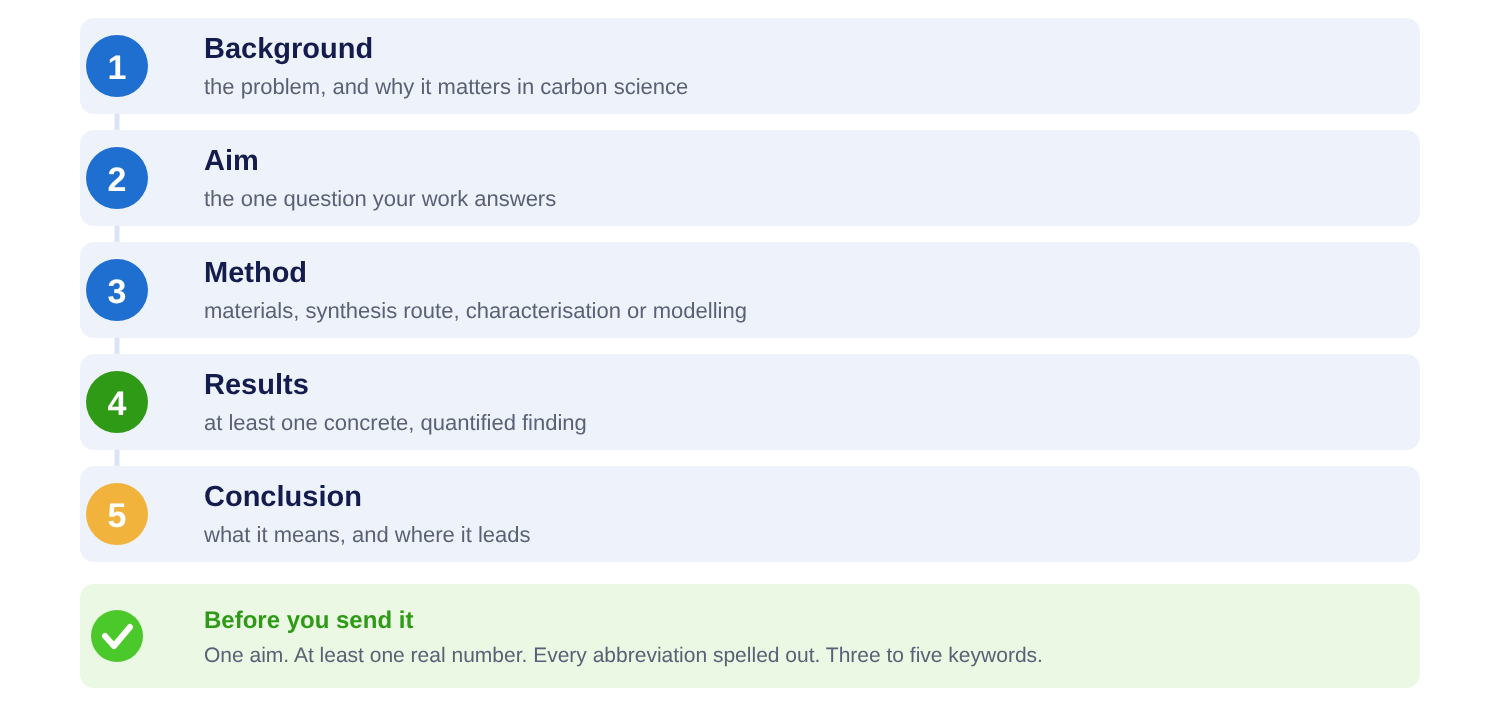
Build your abstract in five parts: 1 Background, the problem and why it matters in carbon science; 2 Aim, the one question your work answers; 3 Method, materials, synthesis route, characterisation or modelling; 4 Results, at least one concrete, quantified finding; 5 Conclusion, what it means and where it leads. Before you send it: one aim, at least one real number, every abbreviation spelled out, three to five keywords.

Sending it

Sending us your abstract

  1. 01

    Prepare

    Prepare your abstract using the five parts above and choose your session.

  2. 02

    Submit

    Submit it through the Submission page, or email it to secretary@carbonscitech.com with your session named in the subject line.

  3. 03

    Hear back

    Receive the committee’s decision, normally within 24 to 48 hours.

  4. 04

    Register

    Complete your registration to confirm your place on the poster floor.

  5. 05

    Present

    Bring your printed poster to Dresden and present it during the judged viewing session.

After you submit
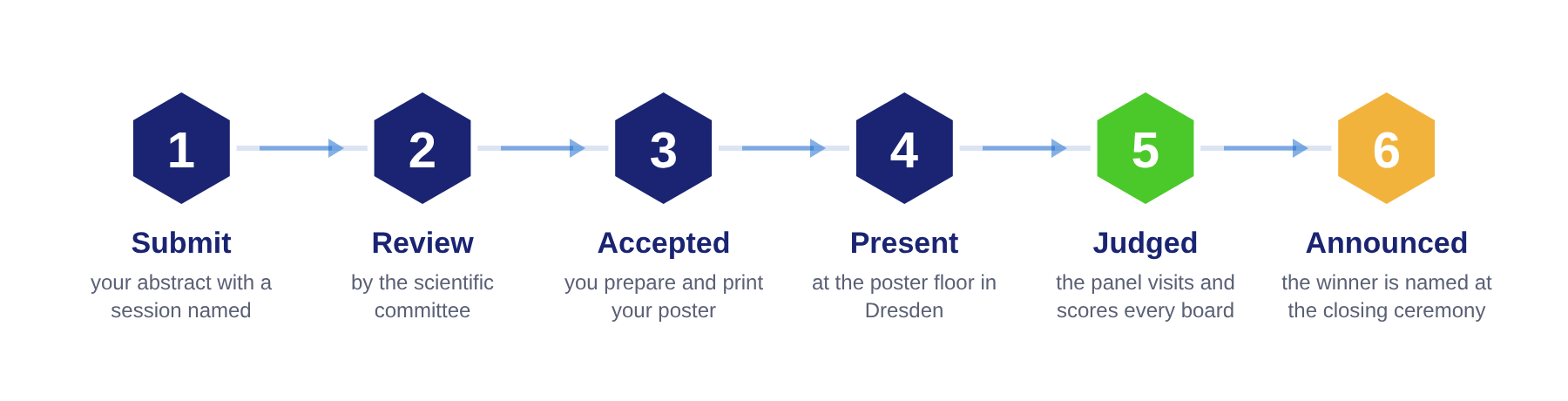
From abstract to closing ceremony

What happens after you submit: 1 Submit your abstract and name your session; 2 The scientific committee reviews it against that session; 3 Accepted authors are notified and prepare and print their posters; 4 You present at the poster floor in Dresden; 5 The judging panel visits and scores every poster; 6 The Best Poster winner is announced at the closing ceremony.
Swipe to see all six steps

On the poster floor in Dresden

Posters are displayed for the full day and judged during a dedicated viewing session, when presenters stand with their boards and the panel comes round. Coffee is served on the poster floor, so delegates browse between sessions rather than only during the judged slot.

Poster format
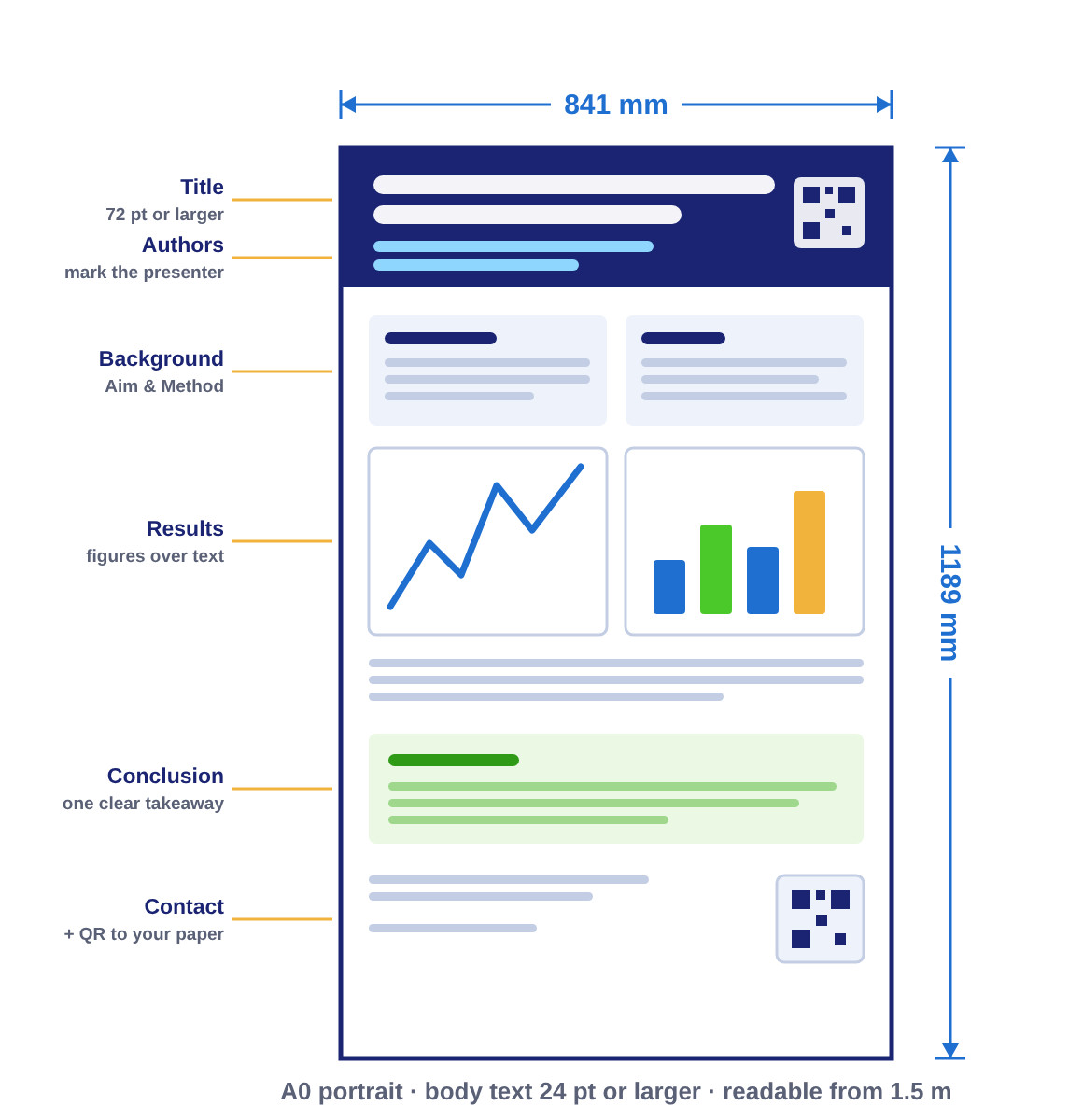
Poster format requirements

Size
A0 portrait, 841 mm wide × 1189 mm tall
Orientation
Portrait only
Printing
Bring your poster printed; printing is not available at the venue
Mounting
Boards and fixings are provided by the organisers
Title block
Title, all authors, affiliations and the presenting author’s name
Text size
Title at least 72 pt; body text at least 24 pt, readable from 1.5 metres
Setup
Mount your poster before the first session on your presentation day
Removal
Take your poster down at the end of the day; posters left behind are discarded
Poster layout guide for an A0 portrait poster, 841 by 1189 mm: title at 72 pt or larger and authors with the presenter marked at the top; background, aim and method next; results as figures over text; a conclusion with one clear takeaway; contact details and a QR code to your paper at the bottom. Body text 24 pt or larger, readable from 1.5 metres.

Tips

Practical notes for presenters

One idea per poster

A poster that makes one point well beats one that makes four badly.

Work in progress is welcome

Preliminary results are fine if the method is sound and you say what is still open.

Name the real-world link

Say who could use your result, in industry, policy or another lab.

Team posters

List every author and mark the presenting author clearly.

Students are judged on the same criteria

There is no separate student category, and students have won on merit at previous editions.

Present in person

The award applies to posters presented in person in Dresden.

Bring business cards or a QR code

The contacts you make at your board are the main reason to be there.

Prepare a two-minute version

Most people who stop will give you two minutes, not twenty.

New to presenting a poster?

A poster is the easiest way into a conference like this one. You get direct feedback from people who have spent decades on your problem, you meet potential supervisors and collaborators face to face, and you leave with your name and your work in front of the field. Many of our speakers presented their first poster at a conference much like this.

If this is your first poster, email us and we will send you guidance on layout and on presenting.

In brief

Poster awards in brief

Poster awards in brief: 27 scientific sessions, 5 research themes, 3 days in Dresden, a 24 to 48 hour abstract decision, and 2 Best Poster Awards.
Swipe to see all five
Conference
C-Horizon 2027, 3rd Edition of Carbon Science and Technology
Dates
November 8–10, 2027
Venue
Courtyard by Marriott Dresden, Dresden, Germany
Sessions
27 scientific sessions
Award
Best Poster Presentation Award
Winners receive
Certificate, memento and a free pass to the next edition
Entry fee
None — every accepted poster is considered
Abstract deadline
October 28, 2027

Bring your poster to Dresden

Send an abstract by October 28, 2027 and hear back within 24 to 48 hours.